
The nutritional supplement industry is entering 2027 with a stronger focus on targeted nutrition, healthy aging, cognitive wellness, sports nutrition, sleep support, gut health, and immune health.
According to Vitaquest International’s 2027 supplement trends report, ten major categories are expected to influence supplement product development: sleep, gut health, fiber, women’s health, longevity, cognitive health, sports nutrition, men’s health, children’s nutrition, and immune support. The report also highlights an increasing emphasis on multifunctional formulations, ingredient transparency, convenience, and science-backed product positioning. [1]
For supplement brands and purchasing managers, however, identifying a trending ingredient is only the first step. Successful product development also depends on ingredient quality, standardized specifications, scientific evidence, regulatory requirements, formulation compatibility, stability, and reliable supply.
This article reviews the major nutritional supplement market trends expected to influence 2027 and examines key ingredients including Creatine Monohydrate, Omega-3, Ashwagandha Extract, Mushroom Extract, Magnesium Glycinate, L-Theanine, and spermidine.
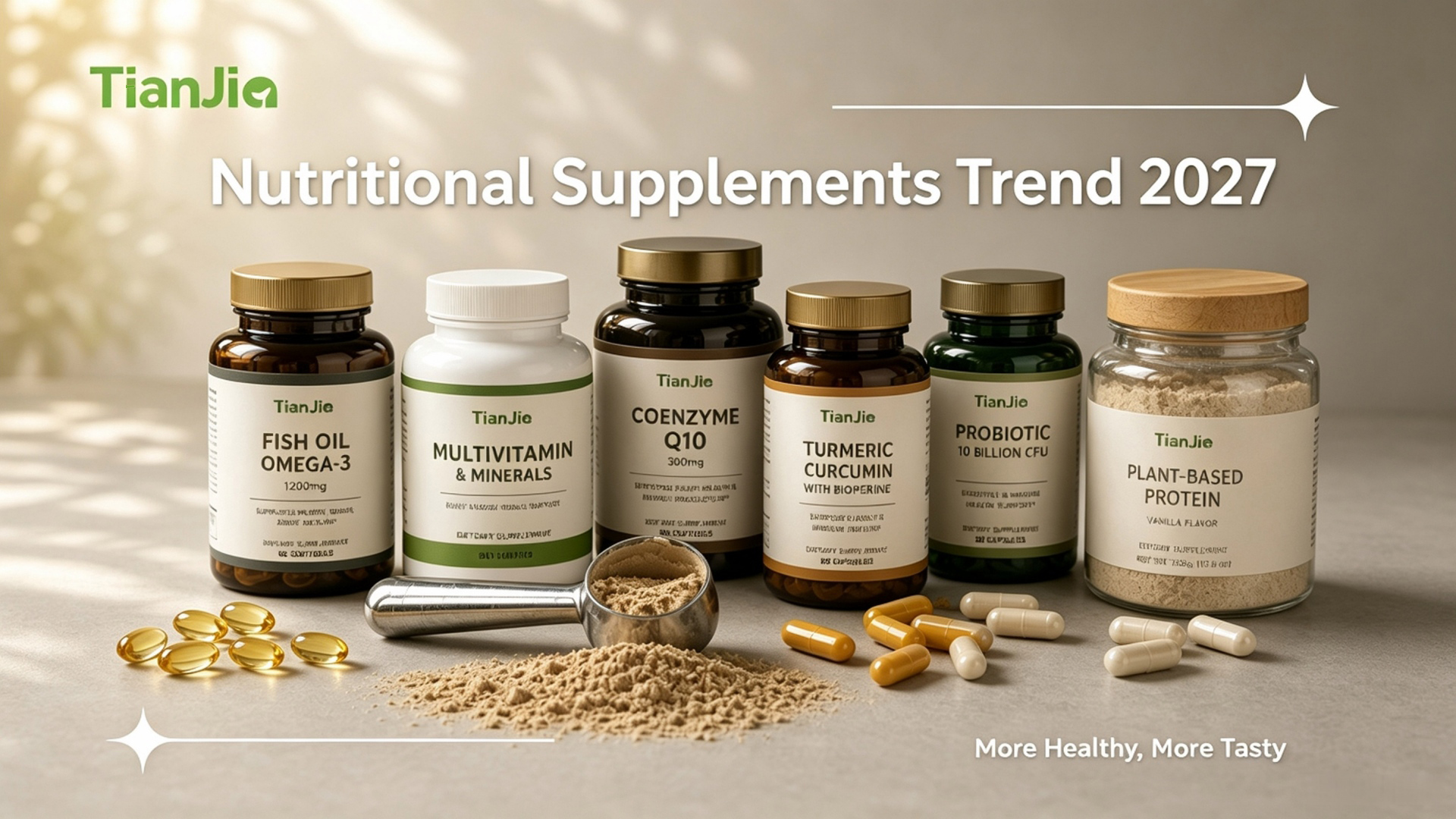
The 2027 Nutritional Supplement Market at a Glance
The ten supplement categories highlighted in the Vitaquest 2027 report are:
| Supplement Category | Representative Ingredients |
| Sleep | Magnesium Glycinate, L-Theanine, Ashwagandha, tomato extract |
| Gut Health | Probiotics, prebiotics, postbiotics, digestive enzymes |
| Fiber | Gum arabic, beta-glucan, resistant starch, arabinogalactan |
| Women’s Health | Magnesium, probiotics, cranberry, D-mannose, botanical extracts |
| Longevity | Spermidine, NMN, resveratrol, CoQ10, fisetin |
| Cognitive Health | Creatine, magnesium L-threonate, citicoline, lion’s mane, bacopa |
| Sports Nutrition | Creatine, protein, electrolytes, beta-alanine, adaptogens |
| Men’s Health | Ashwagandha, zinc, magnesium, creatine, vitamin D |
| Children’s Nutrition | Omega-3, vitamin D, magnesium, probiotics, choline, iron |
| Immune Support | Vitamin D, zinc, vitamin C, beta-glucan, mushroom extracts |
This category mapping is based on the Tianjia R&D team’s review of Vitaquest International’s 2027 supplement trends report.
Selected Market Data
Several categories already have published market forecasts that illustrate their commercial potential.
Sleep-aid supplements: Precedence Research estimates the global sleep-aid supplement market at USD 7.57 billion in 2025, rising to USD 7.95 billion in 2026 and approximately USD 12.46 billion by 2035, representing a projected CAGR of 5.11% from 2026 to 2035. [2]
Sports nutrition: Precedence Research estimates the global sports nutrition market at USD 52.32 billion in 2025 and USD 56.29 billion in 2026, with a projection of approximately USD 107.95 billion by 2035, representing a 7.51% CAGR. [3]
Anti-aging supplements: The global anti-aging supplements market was estimated at USD 4.88 billion in 2025 and USD 5.28 billion in 2026, with a projected value of USD 10.49 billion by 2035 and a CAGR of 7.95%. [4]
Immune-health supplements: Precedence Research estimates the global immune-health supplements market at USD 23.14 billion in 2025, increasing to USD 24.87 billion in 2026 and approximately USD 46.60 billion by 2035, representing a 7.25% CAGR. [5]
These figures are market-research forecasts rather than guarantees of future sales. For purchasing and product-development decisions, they should be considered alongside regional demand, regulatory requirements, competitive products, and actual customer purchasing data.
Sleep Supplements: Moving Beyond Single-Ingredient Formulas
Sleep remains one of the important areas of supplement innovation. The 2027 trend is not necessarily about replacing melatonin, but about developing formulations that address multiple aspects of the consumer’s sleep and relaxation routine.
The ingredients highlighted in the 2027 trend report include:
- Magnesium Glycinate
- L-Theanine
- Ashwagandha
- Tomato extract
- Magnesium L-threonate
- Probiotics
- Dietary fiber
The global sleep-aid supplement market is projected to grow from USD 7.95 billion in 2026 to USD 12.46 billion by 2035, according to Precedence Research. [2]
Magnesium Glycinate
Magnesium is an essential mineral involved in more than 300 enzymatic systems and contributes to normal nerve and muscle function, energy metabolism, protein synthesis, and other physiological processes. [6]
Magnesium glycinate is therefore of interest to formulators developing sleep and relaxation products, although the evidence for magnesium supplementation specifically as a sleep intervention is not equivalent to the well-established physiological functions of magnesium.
For purchasing managers, important specifications can include:
- Elemental magnesium content
- Assay
- Heavy metals
- Microbiological limits
- Solubility
- Particle size
- Source and manufacturing process
- Stability data
L-Theanine
L-Theanine is a naturally occurring amino acid found in tea.
A 2025 systematic review and meta-analysis examined 19 studies involving 897 participants and found statistically significant improvements in several subjective sleep outcomes, including sleep-onset latency and overall subjective sleep quality. However, the researchers also noted that additional research is required to establish optimal dose and duration and to address limitations in the available studies. [7]
A separate 2026 systematic review identified 13 eligible trials involving 550 participants and evaluated L-theanine doses ranging from 50 to 900 mg/day. The authors concluded that the current evidence supports further investigation of L-theanine for healthy sleep, while emphasizing the need for additional high-quality research. [8]
For manufacturers, L-Theanine can therefore be considered a scientifically researched ingredient for sleep-oriented formulations, but product claims should remain consistent with the evidence and applicable regulations.
Gut Health: From Digestion to Broader Wellness
Gut health continues to develop beyond traditional digestive-support products.
The 2027 trend report identifies:
- Probiotics
- Prebiotics
- Postbiotics
- Digestive enzymes
- Bacteriophages
as important ingredient areas.
Postbiotics
Postbiotics have attracted significant attention because they provide another approach to microbiome-oriented formulation.
The International Scientific Association for Probiotics and Prebiotics (ISAPP) consensus statement defines a postbiotic as a preparation of inanimate microorganisms and/or their components that confers a health benefit on the host. [9]
This definition is important for manufacturers because not every microbial metabolite or fermentation-derived compound automatically qualifies as a postbiotic.
From a formulation perspective, postbiotic ingredients may offer opportunities where stability, processing conditions, shelf life, or storage are important considerations.
However, each ingredient should be evaluated based on its own characterization, stability data, manufacturing process, and clinical evidence rather than assuming that all postbiotics have the same properties.
Dietary Fiber: More Than Digestive Support
Dietary fiber is increasingly positioned around broader nutritional functions rather than only digestive regularity.
The 2027 trend report highlights:
- Gum arabic
- Arabinogalactan
- Beta-glucan
- Resistant starch
as important fiber ingredients.
Fiber can interact with the gut microbiota, and fermentation of certain fibers produces short-chain fatty acids. However, physiological effects depend on the specific type, dose, molecular structure, and fermentation characteristics of the fiber.
Formulation Considerations
For purchasing managers, fiber selection should consider:
- Dietary fiber assay
- Solubility
- Viscosity
- Particle size
- Fermentation characteristics
- Sensory impact
- Recommended dosage
- Microbiological quality
- Heavy metals and contaminants
- Compatibility with powders, gummies, RTD beverages, or capsules
This is particularly important because the same category name—such as “dietary fiber”—can represent ingredients with substantially different technological and physiological characteristics.

Women’s Health: More Targeted Formulations
Women’s health is expanding beyond a narrow focus on menopause.
The 2027 trend report identifies ingredients such as:
- Magnesium
- Probiotics
- Cranberry
- D-mannose
- Chasteberry
- Maca Extract
- Black cohosh
- Siberian rhubarb
as potential formulation areas.
The broader trend is toward products designed around specific life stages and health objectives.
For manufacturers, botanical ingredients in this category require particular attention to:
- Botanical identity
- Plant part
- Extraction ratio
- Extraction solvent
- Marker compounds
- Standardization
- Pesticide residues
- Heavy metals
- Microbial testing
- Stability
- Regulatory status in the target market
This documentation becomes particularly important when products are intended for international markets.
Longevity and Healthy Aging: Spermidine Enters the Conversation
Healthy aging is becoming an important area of nutritional supplement development.
The 2027 report identifies spermidine, NMN, resveratrol, CoQ10, and fisetin among the ingredients associated with longevity-oriented formulations.
The global anti-aging supplements market is projected to increase from USD 5.28 billion in 2026 to USD 10.49 billion by 2035, according to Precedence Research. [4]
Spermidine
Spermidine is a naturally occurring polyamine found in foods and human tissues.
Interest in spermidine is strongly connected with autophagy, a cellular recycling process.
A landmark 2009 study published in Nature Cell Biology reported that spermidine administration extended lifespan in yeast, flies, worms, and human immune cells in experimental models and linked these effects to autophagy. [10]
However, this should not be interpreted as proof that spermidine supplementation extends human lifespan.
More recent human research is developing. A 2025 proof-of-concept randomized controlled study investigated a spermidine-rich rice-germ extract and biomarkers associated with healthy aging and autophagy. The authors noted that human clinical evidence for specific spermidine doses and autophagy biomarkers had previously been limited. [11]
A 2025 review also examined the potential relationship between spermidine and memory and cognition in aging and aging-related conditions. [12]
What This Means for Buyers
Spermidine is a low-dose, high-value ingredient, so analytical accuracy becomes particularly important.
Purchasing managers should request:
- Spermidine assay
- Analytical method
- Certificate of Analysis
- Batch-to-batch consistency
- Source material
- Active-compound specification
- Contaminant testing
- Stability information
- Third-party testing where appropriate
The supplier’s ability to demonstrate consistent active content can be more important than simply comparing the price per kilogram.
Cognitive Health: Creatine and Emerging Ingredients
Cognitive health is becoming a broader supplement category, with products increasingly marketed toward different age groups and lifestyles.
The 2027 trend report highlights:
- Creatine
- Magnesium L-threonate
- Citicoline
- Lion’s Mane Mushroom Extract
- Bacopa Extract
among the ingredients being explored in cognitive-health formulations.
Creatine Monohydrate
Creatine is best established as a sports-nutrition ingredient, but research has also investigated its potential cognitive effects.
A 2024 systematic review and meta-analysis included 16 randomized controlled trials involving 492 participants. The researchers reported significant effects on memory, attention time, and processing speed, but not on overall cognitive function or executive function. They also rated the certainty of evidence differently across outcomes. [13]
At the same time, other systematic research has reported more equivocal findings, illustrating why cognitive claims should not be overstated. [14]
Therefore, for commercial formulations, the strongest evidence base for creatine remains its established role in sports nutrition and physical performance, while cognitive applications represent an active research area.
Sports Nutrition: From Athletes to Everyday Active Consumers
Sports nutrition remains one of the largest quantified categories in the 2027 trend review.
Precedence Research estimates the global sports nutrition market at USD 52.32 billion in 2025, increasing to USD 56.29 billion in 2026 and approximately USD 107.95 billion by 2035, with a projected CAGR of 7.51%. [3]
The market includes products designed for different consumer groups and formats, including powders, tablets, capsules, softgels, liquids, and gummies. [3]
Important ingredients include:
- Creatine Monohydrate
- Plant Protein
- Electrolytes
- Beta-alanine
- Adaptogens such as rhodiola rosea extract
Why Creatine Monohydrate Remains Important
Creatine monohydrate has one of the strongest research bases among sports-nutrition ingredients.
For manufacturers, commercial requirements can extend beyond chemical purity.
Important specifications may include:
- Creatine assay
- Particle size
- Mesh specification
- Solubility
- Moisture
- Heavy metals
- Microbiology
- Residual solvents where applicable
- Packaging
- Shelf life
- Batch consistency
Different formats may require different particle-size distributions or processing characteristics.
For example, a powder intended for a capsule application may have different technical requirements from a product intended for an RTD beverage.

Men’s Health: Multifunctional Formulations
Men’s health products are also moving toward broader formulations rather than focusing on one single target.
The 2027 trend report highlights:
- Ashwagandha Extract
- Zinc
- Magnesium
- Creatine
- Vitamin D
as relevant ingredients.
Ashwagandha Extract
Ashwagandha (Withania somnifera) has attracted substantial research attention, particularly in relation to stress and anxiety.
A 2024 systematic review and meta-analysis included nine randomized controlled trials involving 558 participants and reported statistically significant effects on perceived stress, anxiety measures, and serum cortisol. However, the authors also noted limitations and the need for further research on long-term safety. [15]
The U.S. National Institutes of Health Office of Dietary Supplements also reviews evidence concerning ashwagandha and reports that some clinical studies have suggested benefits for stress, anxiety, and sleep, while noting that evidence varies by preparation and that safety considerations remain important. [16]
For ingredient sourcing, “Ashwagandha Extract” alone is not a sufficient specification.
A professional purchasing specification may include:
- Botanical identity
- Root versus leaf or whole-plant material
- Extraction ratio
- Withanolide content
- Analytical method
- Residual solvents
- Pesticide testing
- Heavy metals
- Microbiology
- Country of origin
- Stability
- Regulatory documentation
Standardized extracts should be evaluated based on their actual specification rather than assuming that all ashwagandha extracts have equivalent efficacy.
Children’s Nutrition: Omega-3 and Nutrient-Dense Formats
Children’s nutrition is another category where product design and ingredient quality must work together.
The 2027 trend report identifies:
- Omega-3
- Vitamin D
- Magnesium
- Probiotics
- Choline
- Iron
as important ingredients.
Omega-3
Omega-3 fatty acids include several different fatty acids, with EPA and DHA being important long-chain omega-3s.
The NIH Office of Dietary Supplements notes that omega-3 fatty acids are polyunsaturated fatty acids found in foods and dietary supplements and reviews their roles and health evidence. [17]
For children’s products, formulation requirements can be especially demanding because taste and odor strongly influence consumer acceptance.
Purchasing and formulation teams should consider:
- EPA/DHA concentration
- Oxidation indicators
- Heavy metals and contaminants
- Source
- Stability
- Flavor and odor
- Packaging
- Serving size
- Regulatory requirements for the target market
Omega-3 therefore represents not only an ingredient opportunity but also a sensory and stability challenge.
Immune Support: Beta-Glucan and Mushroom Extracts
Immune-support products continue to be an important supplement category.
Precedence Research estimates the global immune-health supplements market at USD 23.14 billion in 2025, increasing to USD 24.87 billion in 2026 and approximately USD 46.60 billion by 2035, with a CAGR of 7.25%. [5]
The 2027 trend report highlights:
- Vitamin D
- Zinc
- Vitamin C
- Beta-glucan
- Medicinal mushroom extracts
as important ingredient groups.
Mushroom Extract
Medicinal mushrooms such as:
- Reishi Mushroom Extract
- Shiitake Mushroom Extract
- Lion’s Mane Mushroom Extract
contain various bioactive compounds, including polysaccharides and beta-glucans.
A review published in Molecules describes medicinal mushrooms as sources of compounds including β-glucans, triterpenes, phenolic compounds, and sterols and discusses their growing interest in functional-food applications. [18]
However, mushroom extracts are not interchangeable.
Different species, extraction methods, raw materials, and standardization systems can produce substantially different compositions.
For this reason, buyers should specify:
- Mushroom species
- Scientific name
- Plant/fungal part used
- Extraction ratio
- Extraction method
- Beta-glucan content
- Polysaccharide specification
- Triterpene content where applicable
- Heavy metals
- Pesticide residues
- Microbiology
- Adulteration testing
- Country of origin
The scientific literature also emphasizes that beta-glucans from different sources can differ in structure, physical properties, and biological activity. [19]
Nutritional Supplement Solutions for 2027
For ingredient manufacturers and supplement brands, the 2027 market is likely to reward suppliers that can provide more than individual raw materials.
A complete nutritional supplement solution may include:
- · Ingredient sourcing
- · Ingredient standardization
- · Formulation support
- · Flavor development
- · Sweetening systems
- · Dosage-form development
- · Stability support
- · Documentation
- · OEM/ODM manufacturing
- · Quality management
Tianjia, as one supplier with our own creatine monohydrate production line, plant protein production line, food flavoring production line, and healthy food and nutraceutical ingredients (such as herbal extracts and healthy sweetener, dietary fiber, and prebiotics) portfolio, providing not just raw materials but also solutions for healthy food and nutritional supplements manufacturers, helping optimize present formulations and develop innovative formulations with better taste and texture.
For manufacturers developing 2027 products, Tianjia team can help connect ingredient sourcing, formulation, sensory performance, and manufacturing.
The 2027 nutritional supplement market is expected to be shaped by several interconnected trends:
- · Targeted health and wellness
- · Healthy aging
- · Cognitive health
- · Sports and active nutrition
- · Sleep support
- · Gut health
- · Immune support
- · Clean-label and transparent formulations
- · Convenient delivery formats
- · Evidence-backed ingredient positioning
Among the ingredients attracting attention are Creatine Monohydrate, Omega-3, Ashwagandha Extract, Mushroom Extract, Magnesium Glycinate, L-Theanine, and spermidine.
As is said by our R&D team leader, Robin, as the supplement industry becomes more evidence-driven, ingredient quality, transparency, formulation expertise, and supply reliability will become increasingly important competitive factors.
For brands preparing their 2027 product pipeline, selecting the right ingredient supplier early can help reduce formulation risk and create a stronger foundation for product development.
References
[1] Vitaquest International. 10 Supplement Trends Every Brand Should Watch in 2027. 2026.
[2] Precedence Research. Sleep Aid Supplements Market Size and Forecast 2026–2035. Updated February 13, 2026.
[3] Precedence Research. Sports Nutrition Market Size, Production Volume, Consumer Demand, Pricing Analysis, Distribution Performance, Market Share, and Industry Outlook. Updated July 27, 2026.
[4] Precedence Research. Anti-Aging Supplements Market Size and Trends 2026–2035. Updated June 22, 2026.
[5] Precedence Research. Immune Health Supplements Market Size and Trends 2026–2035. Updated January 30, 2026.
[6] National Institutes of Health, Office of Dietary Supplements. Magnesium — Health Professional Fact Sheet.
[7] Bulman A, D’Cunha NM, Marx W, Turner M, McKune A, Naumovski N. The effects of L-theanine consumption on sleep outcomes: A systematic review and meta-analysis. Sleep Medicine Reviews. 2025;81:102076. doi:10.1016/j.smrv.2025.102076.
[8] Cotter J, Caddick CE, Harper JL, Ebajemito JK. Examining the effect of L-theanine on sleep: A systematic review of dietary supplementation trials. Nutritional Neuroscience. 2026;29(2):224–238. doi:10.1080/1028415X.2025.2556925.
[9] Salminen S, Collado MC, Endo A, et al. The International Scientific Association for Probiotics and Prebiotics (ISAPP) consensus statement on the definition and scope of postbiotics. Nature Reviews Gastroenterology & Hepatology. 2021;18:649–667. doi:10.1038/s41575-021-00440-6.
[10] Eisenberg T, Knauer H, Schauer A, et al. Induction of autophagy by spermidine promotes longevity. Nature Cell Biology. 2009;11:1305–1314. doi:10.1038/ncb1975.
[11] Bruno G, La Monica M, Ziegenfuss TN. Effects of Spermidine-Rich Rice Germ Extract Supplement on Biomarkers of Healthy Aging and Autophagy—Proof-of-Concept Pilot Study. Alternative Therapies in Health and Medicine. 2025;31(6):9–13.
[12] Zou M, Li D, Yang Y. The memory- and cognition-facilitating effects of spermidine in aging and aging-related disorders. Ageing Research Reviews. 2025;109:102787. doi:10.1016/j.arr.2025.102787.
[13] Xu C, Bi S, Zhang W, Luo L. The effects of creatine supplementation on cognitive function in adults: A systematic review and meta-analysis. Frontiers in Nutrition. 2024;11:1424972. doi:10.3389/fnut.2024.1424972.
[14] McMorris T, Hale BJ, Pine BS, Williams TB. Creatine supplementation research fails to support the theoretical basis for an effect on cognition: Evidence from a systematic review. Behavioural Brain Research. 2024;466:114982. doi:10.1016/j.bbr.2024.114982.
[15] Arumugam V, Vijayakumar V, Balakrishnan A, et al. Effects of Ashwagandha (Withania somnifera) on stress and anxiety: A systematic review and meta-analysis. Explore. 2024;20(6):103062. doi:10.1016/j.explore.2024.103062.
[16] National Institutes of Health, Office of Dietary Supplements. Ashwagandha: Is it helpful for stress, anxiety, or sleep? Health Professional Fact Sheet.
[17] National Institutes of Health, Office of Dietary Supplements. Omega-3 Fatty Acids — Health Professional Fact Sheet.
[18] Muszyńska B, et al. Medicinal Mushrooms: Their Bioactive Components, Nutritional Value and Application in Functional Food Production—A Review. Molecules. 2023;28(14):5393. doi:10.3390/molecules28145393.
[19] Singh R, Bhardwaj S. β-glucans: A potential source for maintaining gut microbiota and the immune system. Frontiers in Nutrition. 2023;10:1143682. doi:10.3389/fnut.2023.1143682.
Related Products
Tianjiachem is the production departments of Tianjia Group, we have following four manufacturing plants: creatine manufacturing plant, food flavoring manufacturing plant, plant protein manufacturing plant, and stevia manufactuing plant. Besides, we also integrate supply chain to provide bulk other ingredients.
Yes. Tianjia portfolio covers several of the categories highlighted in the 2027 supplement trends, including creatine, plant proteins, natural herbal extracts, amino acids, natural sweeteners, fibers and prebiotics.
Our own creatine, plant protein, and flavor production lines, allowing the company to support manufacturers beyond individual raw-material sourcing.
Price is only one part of ingredient sourcing. Purchasing managers should also evaluate:
· Ingredient specifications and purity
· Standardization and active-marker content
· Certificates and quality documentation
· Regulatory requirements for the target market
· Available particle sizes or product formats
· Batch-to-batch consistency
· MOQ and production capacity
· Lead time and supply stability
· Packaging and storage requirements
· Technical and formulation support
ISO9001, ISO22000, Kosher, HALAL, FDA, Intertek, SGS, GMP...
If you are going to launch new products into your target markets, or need ingredient sourcing, specifications, formulations support, flavor blendings support, etc... you can send Tianjia your requirements.
To help our team respond efficiently, please include:
· Your product type and dosage form
· Target ingredients
· Required specifications or active content
· Estimated annual or monthly quantity
· Target market/country
· Packaging requirements, if applicable
Post time: Sep-11-2026