
Food, beverage, sports nutrition and nutraceutical manufacturers are increasingly looking for ways to improve ingredient stability, taste, processing performance, controlled release and formulation flexibility.
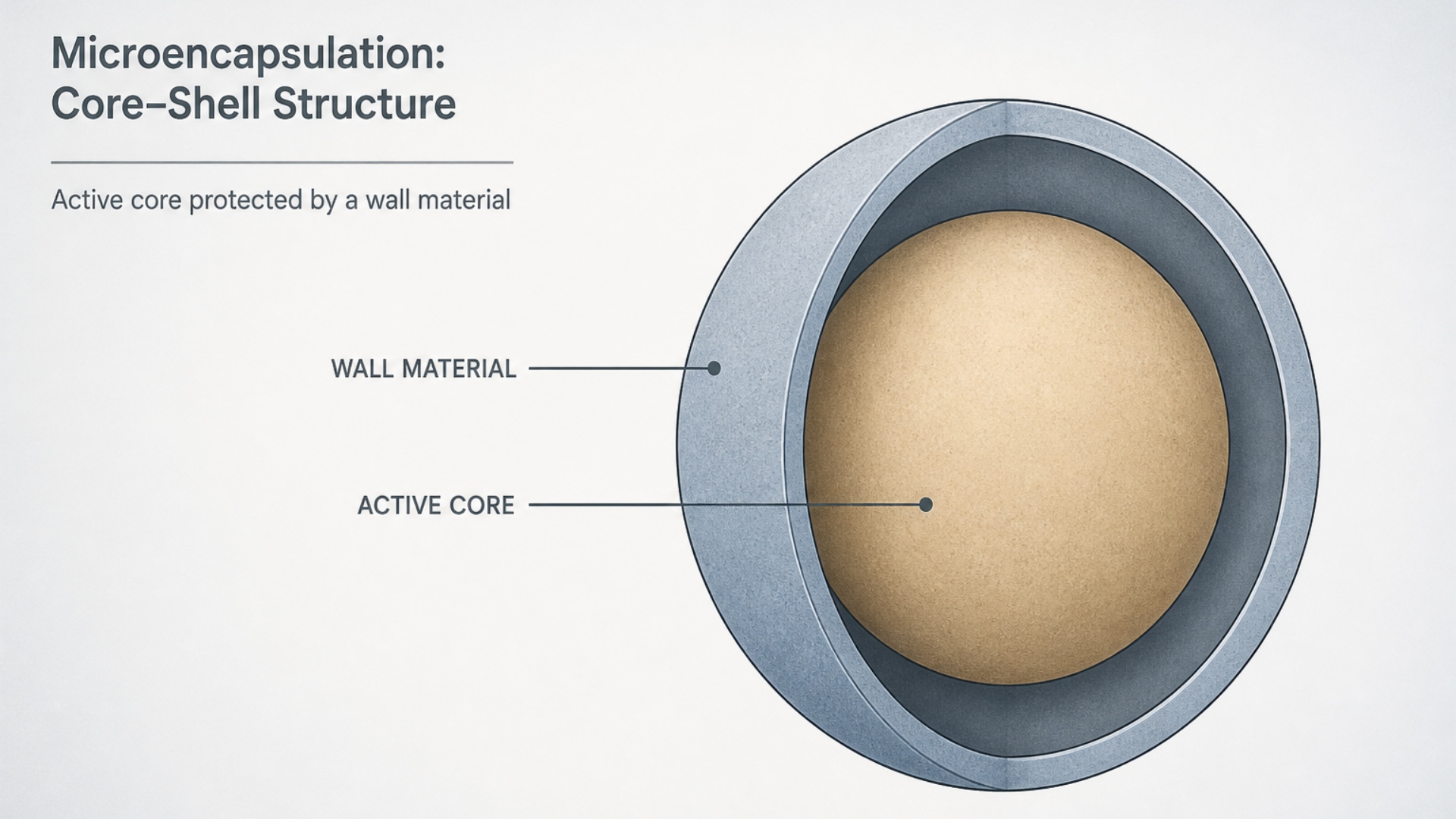
Encapsulation technology has become an important formulation approach because it can place an active ingredient inside a protective coating or matrix. Instead of allowing an ingredient to interact directly with the surrounding food or beverage system, encapsulation can create a physical barrier between the active ingredient and its environment.
For B2B manufacturers, however, encapsulation should not be treated simply as a new ingredient format. The appropriate encapsulation technology depends on the ingredient, target application, pH, temperature, water activity, processing conditions, release profile and regulatory requirements.
Recent research into encapsulated creatine demonstrates this clearly. Creatine monohydrate is highly stable in dry form but substantially less stable once exposed to water, particularly under acidic conditions. This makes encapsulation especially relevant for liquid, RTD, gummy and other challenging formats.
The same formulation principle is relevant when manufacturers evaluate encapsulated food acids, flavors, preservatives and other functional ingredients.
For ingredient buyers and product developers, the key question is therefore not simply "What can be encapsulated?" but:
Which encapsulation technology and ingredient specification are appropriate for my finished product and manufacturing process?
What Is Encapsulation Technology?
Encapsulation is a technology used to surround an active ingredient with a protective material or incorporate the active into a carrier matrix.
Depending on the technology, the encapsulated ingredient may be designed to:
- · Protect sensitive ingredients from moisture, oxygen, heat or other environmental factors
- · Reduce direct interaction between an active ingredient and the surrounding formulation
- · Improve handling and dispersion
- · Mask undesirable tastes or odors
- · Improve compatibility between ingredients
- · Modify the release behavior of an ingredient
- · Support incorporation into more challenging food and beverage formats
- · Improve the stability of an ingredient during processing or storage
In this article, Robin, Tianjia R&D team leader, identifies several commercial encapsulation platform families, including protein-matrix, spray-dried, fluid-bed/coated and lipid/liposome technologies. These platforms are not interchangeable. Their suitability depends on the target formulation and process conditions.
Why Encapsulation Is Becoming More Important for Food and Beverage Manufacturers
Modern products are moving beyond conventional powders and capsules.
Manufacturers are developing:
- · Functional beverages
- · RTD nutrition drinks
- · Sports nutrition products
- · Nutritional gummies
- · Functional foods
- · Instant powders
- · Stick packs
- · Bakery products
- · Meat and processed-food products
- · Fortified foods
- · Convenience nutrition products
These formats can create very different formulation challenges.
An ingredient that performs well in a dry powder may behave differently after exposure to water. Likewise, an ingredient that remains stable during room-temperature storage may respond differently to acidic conditions, heat treatment or high-moisture processing.
Thus Tianjia R&D team highlights four variables that are particularly important when evaluating encapsulated creatine:
pH + temperature + water activity + time
These variables should be considered together rather than evaluating ingredient stability using a single number or a generic supplier specification.
This principle can also guide the development and sourcing of encapsulated food ingredients more broadly.
Microencapsulated Creatine: An Important Example of Encapsulation Technology
Creatine is a useful example of why encapsulation technology matters.
Creatine monohydrate is widely used in sports nutrition, but its behavior changes significantly when it is placed in an aqueous environment. In solution, creatine can convert to creatinine, with degradation influenced by factors including pH and temperature.
According to the experimental data, creatine monohydrate has reported solubility of approximately 13 g/L at 25°C, while its stability is considerably stronger in dry powder form than in solution.
This creates a formulation challenge for manufacturers developing:
- · Creatine RTD beverages
- · Creatine shots
- · Creatine gummies
- · Functional drinks
- · Liquid sports nutrition products
The data also identifies water activity as an important factor in stability and explains that chemical degradation can occur alongside physical changes such as crystallization and pH drift.
Why Microencapsulated Creatine Can Be Considered
Encapsulation can provide a physical barrier around creatine and is being investigated and commercialized as a way of addressing some of the formulation challenges associated with liquid applications.
A human pharmacokinetic study cited in this report investigated 3 g of microencapsulated creatine monohydrate in a 70 mL ready-to-drink format in 10 physically active males. The study demonstrated that the encapsulated creatine remained bioavailable in the tested aqueous format. Importantly, the report emphasizes that this evidence demonstrates bioavailability—not proof of superior exercise efficacy or dose equivalence.
This distinction is important for B2B purchasing teams.
A supplier's encapsulation claim should therefore be evaluated according to the actual ingredient, dosage, matrix, processing conditions and evidence available, rather than relying only on general claims about encapsulation.
Encapsulated Citric Acid for Food and Beverage Applications
Citric acid is widely used in food and beverage formulations for acidity regulation and flavor profiles.
In an encapsulated format, the formulation objective can be different from simply adding free citric acid directly to a product.
Encapsulated citric acid may be considered when manufacturers need better control over the interaction between the acid and other formulation components.
Potential application areas include:
- · Bakery products
- · Dry beverage mixes
- · Functional foods
- · Confectionery
- · Nutritional products
- · Seasonings
- · Processed foods
- · Controlled-acidification systems
For product developers, the important questions include:
- · What is the required acid release profile?
- · At what stage should acidity develop?
- · How will the encapsulated acid behave during mixing?
- · Will the coating survive the intended processing temperature?
- · How will moisture affect storage stability?
- · Is the encapsulated form compatible with the final food matrix?
These questions follow the same buyer principle established in the encapsulation research: performance should be evaluated under the actual finished-product conditions, rather than relying only on a laboratory model system.
Encapsulated Malic Acid for Controlled Acidity and Flavor
Malic acid provides another interesting opportunity for encapsulation technology.
For food manufacturers, malic acid can contribute to acidity and flavor characteristics. Encapsulation can be considered when formulation developers need to manage the interaction between the acid and the surrounding matrix.
Potential applications may include:
- · Functional beverages
- · Powdered drinks
- · Confectionery
- · Bakery products
- · Nutritional foods
- · Sports nutrition products
- · Flavor systems
The specific encapsulation system should be selected according to the target product.
For example, a dry instant powder and a high-moisture beverage have fundamentally different formulation environments. A coating that performs effectively in a dry system cannot automatically be assumed to provide the same performance in a liquid product.
This is why Tianjia recommends evaluating encapsulated ingredients according to the complete application environment, including formulation composition, processing conditions, packaging and intended shelf life.
Encapsulated Flavor: Improving Formulation Flexibility
Flavor is another important area where encapsulation technology can provide formulation opportunities.
Flavor ingredients can be sensitive to environmental conditions, and direct addition may create challenges related to:
- · Volatility
- · Interaction with other ingredients
- · Processing losses
- · Storage stability
- · Flavor distribution
- · Off-notes from functional ingredients
Encapsulation can help create a physical barrier around flavor components and can be designed around the desired processing and release conditions.
This is particularly relevant for manufacturers developing:
- · Nutritional beverages
- · Sports nutrition products
- · Protein products
- · Functional foods
- · Bakery products
- · Confectionery
- · Instant beverages
- · Nutritional gummies
For products containing ingredients with strong or distinctive sensory characteristics, encapsulated flavor systems can also be evaluated as part of an overall taste and formulation strategy.
Encapsulated Sorbic Acid and Calcium Propionate for Food Preservation
Food manufacturers also have applications for encapsulated preservatives.
Encapsulated sorbic acid and encapsulated calcium propionate can be considered where manufacturers need to manage the interaction and release of preservation systems within a food matrix.
Potential application areas include:
Encapsulated Sorbic Acid
Potential applications include:
· Bakery products
· Confectionery
· Cheese and dairy-related products
· Processed foods
· Dry food systems
Encapsulated Calcium Propionate
Potential applications include:
- · Bread
- · Bakery products
- · Baked goods
- · Flour-based products
- · Other food systems where mold control is an important formulation consideration
The technical objective is not necessarily simply to "make the preservative stronger." Instead, encapsulation can be investigated as a way of managing when and where the ingredient interacts with the food matrix.
For procurement teams, the required specification should therefore include more than assay and purity. It should also address particle characteristics, coating system, release behavior, moisture sensitivity and application performance where relevant.
Encapsulated Fumaric Acid and Tartaric Acid
Other organic acids can also be evaluated for encapsulation depending on the target application.
Encapsulated Fumaric Acid
Fumaric acid is used in food applications where acidity and formulation performance are important. Encapsulation may be considered for products where direct acid addition creates processing, dispersion or interaction challenges.
Potential applications include:
- · Dry beverage mixes
- · Bakery products
- · Confectionery
- · Seasonings
- · Functional food formulations
Encapsulated Tartaric Acid
Tartaric acid can also be considered for encapsulated formulations where manufacturers want to better control its interaction with the surrounding matrix.
Potential application areas may include:
- · Beverage powders
- · Confectionery
- · Bakery products
- · Functional food products
- · Acidified dry mixes
As with other encapsulated ingredients, the appropriate technology should be determined by the final formulation rather than by the ingredient name alone.
Choosing the Right Encapsulation Technology
There is no single encapsulation platform suitable for every ingredient and every finished product.
The research report compares several technology families and emphasizes that platform selection should begin with the process envelope rather than the headline marketing claim.
A B2B buyer should consider at least the following factors:
|
Evaluation factor |
Key question |
| Ingredient | What ingredient needs protection or controlled release? |
| Target format | Powder, RTD, gummy, bakery, meat product or functional food? |
| pH | What is the finished-product pH? |
| Temperature | Will the ingredient experience baking, pasteurization, UHT or other thermal processing? |
| Water activity | Will the ingredient remain dry or be exposed to moisture? |
| Release | Should the ingredient release immediately or under defined conditions? |
| Particle size | What particle-size range is suitable for the final product? |
| Sensory profile | Is taste or odor masking required? |
| Shelf life | What stability must be maintained through the intended shelf life? |
| Regulatory requirements | Is the ingredient and its intended use acceptable in the target market? |
| Documentation | Can the supplier provide lot-level CoAs and application data? |
The research report specifically recommends requesting stability inf
Encapsulation for Gummies, RTDs and Other Modern Formats
The development of modern nutrition formats is one reason encapsulation technology has attracted increasing attention.
The research report identifies gummies and RTDs as particularly challenging formats for creatine because they combine factors such as moisture, acidity, heat and extended shelf life.
For manufacturers, the broader lesson is applicable beyond creatine:
The more demanding the finished-product environment, the more important application-specific encapsulation data becomes.
For example:
RTD Beverages
Important considerations include pH, heat processing, water exposure, sedimentation, dispersion and shelf life.
Nutritional Gummies
Important considerations include moisture, acids, heating during processing, matrix interactions, sensory characteristics and analytical testing.
Bakery Products
Important considerations include baking temperature, release behavior, moisture migration and compatibility with the dough or batter.
Dry Powders and Stick Packs
Important considerations include moisture protection, particle size, flowability, dispersion and storage stability.
Functional Foods
Important considerations include matrix compatibility, sensory properties, processing conditions and regulatory requirements.
ormation using defined pH, temperature, time, finished matrix and analytical methods rather than accepting an isolated percentage-retention number.
Why Application-Specific Data Matters
One of the most important conclusions from the research report is that a supplier's generic stability data should not automatically be transferred to a buyer's finished product.
For example, a dry powder can have excellent stability while the same active ingredient may behave differently after being dissolved in an acidic beverage.
Similarly, a laboratory test conducted at one pH and temperature cannot automatically establish shelf life at another pH, another processing temperature or in another food matrix.
The report therefore recommends that buyers ask for data from the actual finished matrix, with clearly defined test conditions and timepoints.
This approach can help manufacturers reduce formulation risk before moving from laboratory trials to pilot and commercial production.
Tianjia Encapsulation Ingredients for B2B Formulation Development
For ingredient manufacturers and procurement teams, Tianjia focuses on providing ingredients and formulation solutions for food, beverage, sports nutrition and nutraceutical applications.
Tianjia ingredient portfolio includes creatine, flavors, plant proteins, amino acids, natural sweeteners, herbal extracts and other functional ingredients. Our manufacturing plants include dedicated production lines for food flavorings, creatine series, protein series, and stevia sweetener .
Encapsulated creatine is one area where Tianjia can support manufacturers exploring new-generation sports nutrition formats.
For companies evaluating encapsulated ingredients such as encapsulated creatine, encapsulated citric acid, encapsulated malic acid, encapsulated flavor, encapsulated sorbic acid, encapsulated calcium propionate, encapsulated fumaric acid and encapsulated tartaric acid, the appropriate specification should be determined according to the intended application and technical requirements.
Instead of selecting an encapsulated ingredient solely according to price per kilogram, buyers should evaluate:
Ingredient → Encapsulation technology → Application → Processing → Stability → Regulatory requirements → Commercial supply
This procurement sequence follows the central principle of the research report: encapsulation should be evaluated according to the process envelope and evidence, not simply the technology name or marketing claim.
Conclusion: Encapsulation Is a Formulation Strategy, Not Just an Ingredient Format
Encapsulation technology is opening new possibilities for food, beverage, sports nutrition and nutraceutical manufacturers.
Microencapsulated creatine demonstrates the importance of this technology particularly well: an ingredient can behave very differently in a dry powder compared with an aqueous or acidic finished product. The research evidence shows why pH, temperature, water activity, processing conditions and shelf life need to be considered together.
The same formulation mindset can be applied when evaluating encapsulated acids, flavors and preservatives.
At Tianjia, we understand that ingredient sourcing is closely connected with formulation performance. If you are developing new products using encapsulated creatine, encapsulated organic acids, encapsulated flavors or encapsulated preservatives, contact Tianjia to discuss your ingredient specifications, target application and B2B sourcing requirements.
References
1. Hone et al. (2017). Microencapsulated creatine monohydrate pharmacokinetic study. Journal of Dietary Supplements.
2. Jäger, R., Purpura, M., Shao, A., Inoue, T., & Kreider, R. B. (2011). Analysis of the efficacy, safety, and regulatory status of novel forms of creatine. Amino Acids.
3. Kreider, R. B., Jäger, R., & Purpura, M. (2022). Critical review of creatine and related compounds. Nutrients.
4. Uzzan et al. (2009). Study of creatine degradation kinetics under different water-activity and temperature conditions.
5. Mordor Intelligence. Microencapsulated Food Ingredient Market.
6. Health Canada. (2024). Creatine Monohydrate Monograph.
7. FDA. GRAS Notice No. 931.
Related Products

Tianjia Encapsulated Creatine

Tianjia Encapsulated Citric Acid

Tianjia Encapsulated Malic Acid
Tianjia Encapsulated Sorbic Acid
Tianjia Encapsulated Flavor
T
A
db
T
Post time: Sep-18-2026