
As consumers increasingly focus on healthy ageing, physical performance, recovery, and long-term wellness, supplement brands are looking beyond single-ingredient products. Creatine and astaxanthin are two ingredients attracting growing attention because they support different aspects of sports health and nutrition.
Creatine, particularly creatine monohydrate, is well established for its role in muscle energy metabolism, strength, and lean tissue. Astaxanthin, a natural carotenoid derived from Haematococcus pluvialis, is widely studied for its antioxidant and cellular-protective properties.
For manufacturers, however, successful product development requires more than simply combining two popular ingredients. Ingredient quality, dosage, stability, formulation compatibility, traceability, and regulatory requirements all need to be considered.
Creatine and Astaxanthin: Two Different Functional Pathways
Creatine and astaxanthin do not perform the same role, which makes them interesting components for complementary sports nutrition formulations.
Creatine monohydrate supports the body’s rapid energy system and has a strong evidence base for improving strength and lean tissue when combined with resistance training. Research has also explored creatine’s potential applications in healthy ageing and cognitive health, although the evidence for cognitive benefits remains developing.
Astaxanthin is a ketocarotenoid known for its antioxidant activity and interaction with lipid-rich environments such as cell membranes. Human research has investigated its potential role in exercise recovery, oxidative-stress regulation, and skin health. However, the evidence is not uniform, and astaxanthin should not be positioned as a universally effective performance-enhancing ingredient.
This distinction is important for responsible product positioning: creatine and astaxanthin may address different nutritional priorities, but there is currently no direct clinical evidence proving a synergistic effect between the two ingredients.
Why Creatine Monohydrate Remains a Key Sports Nutrition Ingredient
Among different forms of creatine, creatine monohydrate remains one of the most extensively studied options.
The source material identifies creatine’s strongest evidence in muscle energy metabolism, strength, and lean tissue. The ISSN position stand cited in the source reports that creatine monohydrate can increase muscle creatine stores by approximately 20–40% and meaningfully support strength and lean tissue when combined with resistance training.
For sports nutrition brands, this makes high-purity creatine monohydrate an important foundation for products such as:
- Powdered sports nutrition products
- Capsules and tablets
- Functional beverages
- Gummies and other innovative dosage forms
- Daily performance and healthy-ageing formulations
For ingredient buyers, however, purity alone is not enough. Impurity control, particle size, consistency, stability, and finished-product compatibility can have a significant impact on the final product.
Natural Astaxanthin for Sports Health and Wellness Formulations
Astaxanthin is naturally sourced from Haematococcus pluvialis and is valued for its antioxidant properties.
The evidence reviewed in the source material suggests that astaxanthin may have potential applications in exercise recovery and skin health, but results across clinical studies are not completely consistent. For example, one 2026 meta-analysis reported reductions in certain post-exercise muscle-damage biomarkers, while another meta-analysis did not find a significant change in creatine kinase.
For brands developing sports health & nutrition products, this means astaxanthin is best positioned based on substantiated functions rather than exaggerated claims.
Product developers should also pay close attention to source authenticity, isomer profile, esterification, carotenoid purity, oxidative stability, and traceability.
What Should Buyers Look for in Astaxanthin and Creatine?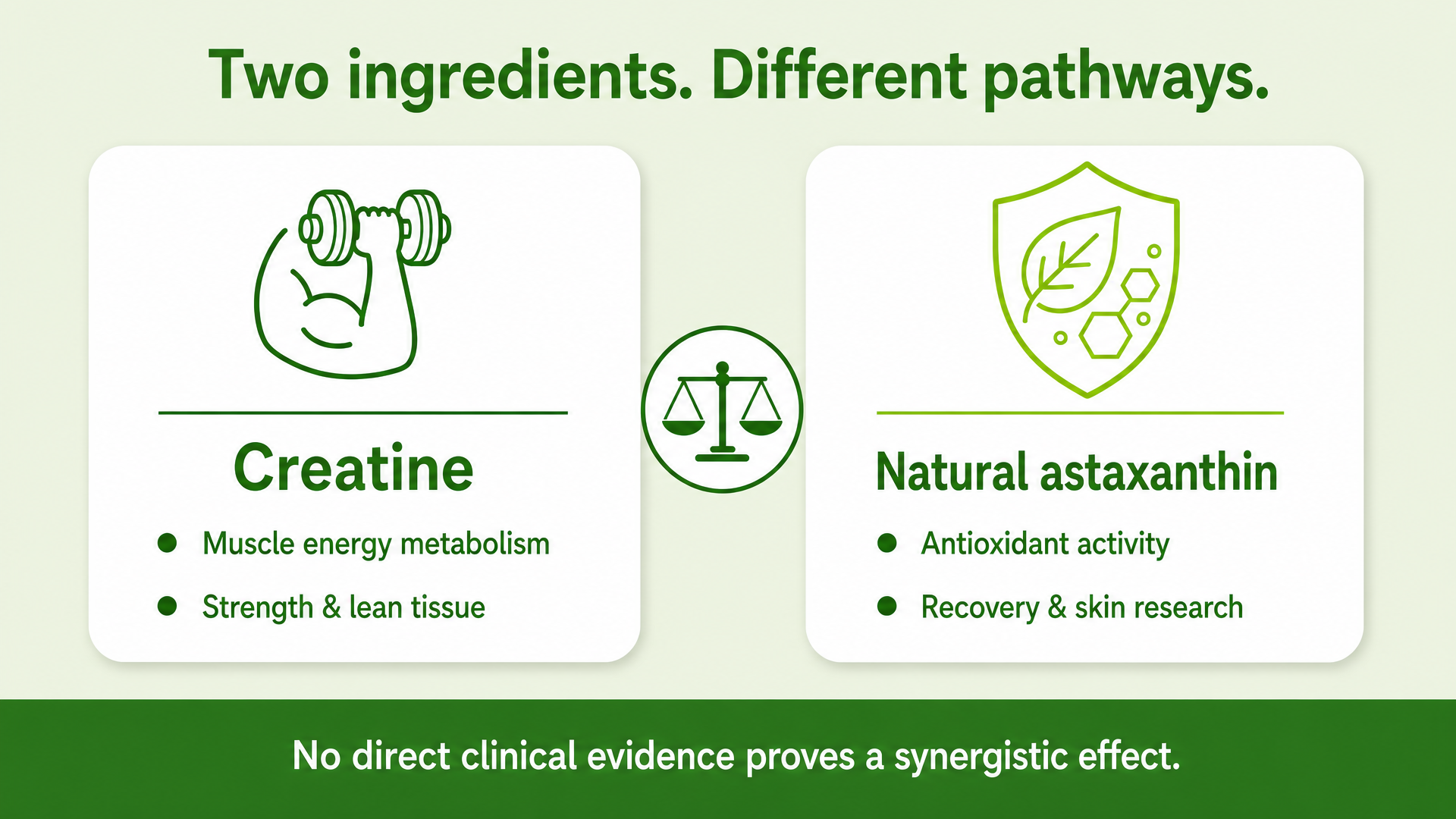
For bulk ingredient purchasing, the quality of the raw material can directly affect formulation performance and finished-product consistency.
Tianjia® Astaxanthin Quality Indicators
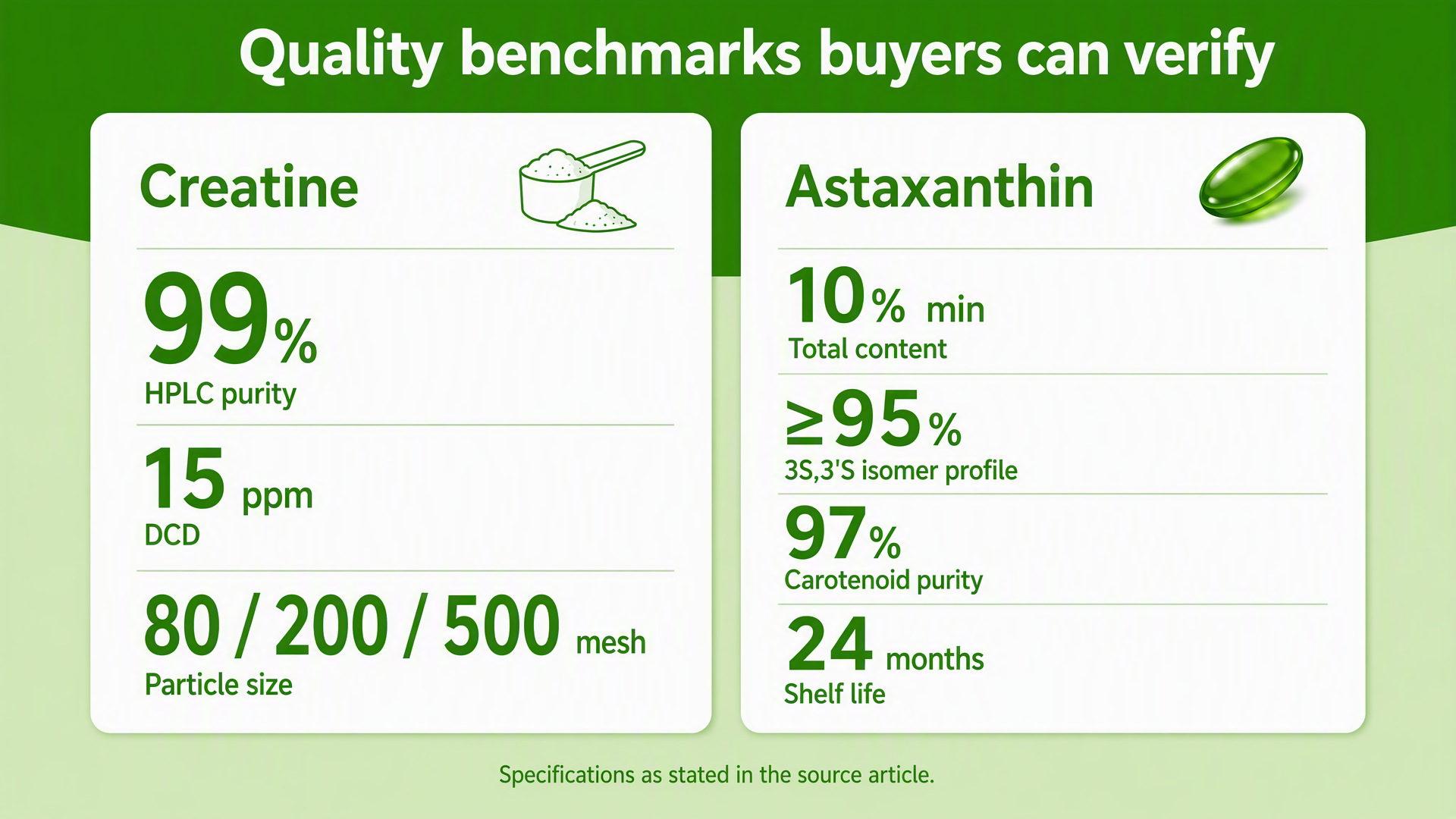
According to the source material, Tianjia® Astaxanthin offers the following quality benchmarks:
| Quality Indicator |
Tianjia® Specification |
| Total astaxanthin content |
10% Min. |
| 3S,3′S isomer profile |
95% Min. |
| Monoester |
70% |
| Diester |
25% |
| Free astaxanthin |
≤5% |
| Carotenoid purity |
97% |
| Shelf life |
24 months |
The source also highlights Haematococcus pluvialis origin verification, non-GMO status, cultivation-environment control, batch-level traceability, two-stage cultivation, supercritical CO₂ extraction, encapsulation, and oxidation protection as important quality and manufacturing considerations.
Tianjia® Creatine Quality Benchmarks
For creatine, Tianjia’s stated quality benchmarks include:
| Quality Indicator |
Tianjia® Specification |
| HPLC purity |
99% |
| Dicyandiamide (DCD) |
15 ppm |
| Particle size |
80 mesh, 200 mesh, 500 mesh |
| Heavy metals |
≤5 ppm |
| Stability |
High stability |
Particle-size options can be particularly relevant when developing different dosage forms, while impurity control and batch consistency are critical considerations for large-scale sports nutrition manufacturing.
From Ingredients to Application-Ready Sports Nutrition Formulations
A major challenge for manufacturers is translating high-quality raw materials into stable finished products.
Creatine can be sensitive to formulation conditions. The source material notes that creatine degradation to creatinine becomes more significant under lower-pH and higher-temperature conditions. This is particularly relevant when developing acidic ready-to-drink beverages.
Astaxanthin presents a different formulation challenge because of its lipophilic nature and sensitivity to oxidation.
Therefore, a successful creatine and astaxanthin formulation should consider the characteristics of each ingredient rather than simply adding both to the same formula.
1. Ready-to-Drink Beverages
For RTD products containing creatine, formulation developers should evaluate:
- pH
- Storage temperature
- Creatine retention
- Creatinine formation
- Appearance
- Taste stability
- Real-time and accelerated stability
The source recommends evaluating different pH conditions and temperatures as part of a structured stability study.
2. Gummies
Gummies can provide an attractive delivery format for wellness and sports nutrition products, but astaxanthin compatibility and oxidation stability require particular attention.
Relevant testing can include:
- Active ingredient retention
- Color retention
- Oxidation indicators
- Three- and six-month stability testing
3. Capsules and Softgels
Capsules are generally a lower-risk format from a formulation perspective. For astaxanthin, oil-based softgels can be particularly suitable because of its lipophilic characteristics, while creatine dosage needs to accommodate its substantially higher daily-use quantity.
The source identifies a typical creatine maintenance range of 3–5 g/day and discusses astaxanthin at milligram-level doses.
Regulatory Considerations for Global Markets
Global brands also need to consider market-specific regulatory requirements when selecting creatine and astaxanthin ingredients.
The source material notes different regulatory frameworks across China, the United States, and the European Union, including requirements relating to natural astaxanthin, Haematococcus pluvialis, novel-food authorization, and permitted applications.
For international buyers, a qualified ingredient supplier should therefore be able to provide appropriate technical and regulatory documentation for the target market.
This may include:
- Product specifications
- Certificate of Analysis (CoA)
- Testing reports
- Source and traceability information
- Stability data
- Regulatory documentation
- Application guidance
- Batch information
Why Choose Tianjia for Creatine and Astaxanthin Solutions?
For sports nutrition and healthy-ageing brands, sourcing ingredients is only the first step. The more valuable approach is to work with a supplier that can support the complete development process.
According to the source material, Tianjia combines:
Supply capability: large-scale production, stable raw-material availability, and more than 15 years of export experience in American and European markets.
Technical service: formulation support, customized specifications, and fast sampling.
Commercial support: competitive pricing, flexible MOQ, and long-term supply agreements.
This approach enables Tianjia to support customers not only with creatine monohydrate and astaxanthin ingredients, but also with application-oriented solutions for sports nutrition, wellness, and healthy-ageing products.
Building Better Sports Nutrition Formulations
The future of sports nutrition is moving beyond simple single-function products. Consumers increasingly seek formulations that fit broader wellness goals, including physical performance, recovery, healthy ageing, and daily nutrition.
Creatine and astaxanthin offer two different nutritional approaches: creatine is strongly associated with muscle energy metabolism and strength, while astaxanthin is studied for antioxidant, recovery, and skin-related applications.
The evidence does not currently support claiming a proven synergistic effect between the two. Instead, their value lies in the possibility of designing formulations that address complementary nutritional priorities while maintaining scientifically responsible positioning.
For brands and bulk ingredient buyers, the key is to evaluate more than headline purity. Source traceability, impurity control, consistency, formulation stability, application data, and regulatory support are all essential when selecting a long-term ingredient partner.
With its creatine monohydrate and astaxanthin capabilities, Tianjia aims to provide scientifically supported, application-ready ingredient solutions for sports health, sports nutrition, and healthy-ageing brands.
For more information about Tianjia’s creatine and astaxanthin ingredients or to discuss customized specifications and formulation requirements, please contact the Tianjia team.
References
1. Kreider RB, Kalman DS, Antonio J, et al. International Society of Sports Nutrition position stand: Safety and efficacy of creatine supplementation in exercise, sport, and medicine. Journal of the International Society of Sports Nutrition. 2017. https://pubmed.ncbi.nlm.nih.gov/28615996/
2. Gonzalez DE, et al. International Society of Sports Nutrition position stand: Effects of dietary antioxidants. Journal of the International Society of Sports Nutrition. 2026. https://pubmed.ncbi.nlm.nih.gov/41701327/
3. Liu S, et al. Astaxanthin and exercise recovery/performance meta-analysis. Nutrients. 2026. https://pubmed.ncbi.nlm.nih.gov/42197030/
4. You T, et al. Astaxanthin and exercise oxidative stress meta-analysis. 3 Biotech. 2026. https://pubmed.ncbi.nlm.nih.gov/41710469/
5. Hasani M, et al. Astaxanthin meta-analysis. Journal of Functional Foods. 2024. https://www.sciencedirect.com/science/article/pii/S1756464624004791
6. Oharomari LK, et al. Exercise + astaxanthin synergy: A review. Antioxidants. 2021;10(6):870. https://www.mdpi.com/2076-3921/10/6/870
7. Astaxanthin: Synthesis and biological activities. Food Chemistry. 2025. https://www.sciencedirect.com/science/article/pii/S0308814625020989
8. Forbes SC, Candow DG. Creatine and muscle, bone and brain function in older adults. Nutrients. 2021.
9. Prokopidis K, et al. Creatine and memory: Systematic review and meta-analysis. Nutrition Reviews. 2023.
10. Ng QX, et al. Astaxanthin and skin health: Systematic review. Journal of Dietary Supplements. 2021.
11. Zhou X, et al. Astaxanthin and skin ageing: Meta-analysis. Nutrients. 2021. https://pubmed.ncbi.nlm.nih.gov/34578794/
12. Commission Implementing Regulation (EU) 2024/1026. European Union. https://eur-lex.europa.eu/legal-content/EN/TXT/?uri=CELEX:32024R1026
13. EFSA. Scientific opinion on astaxanthin oleoresin extended use. 2025. https://efsa.onlinelibrary.wiley.com/doi/10.2903/j.efsa.2025.9737
Disclaimer: This article does not constitute medical advice. Product developers and consumers should consult qualified professionals and review applicable regulations before making health or nutrition claims.
Post time: Aug-25-2026